
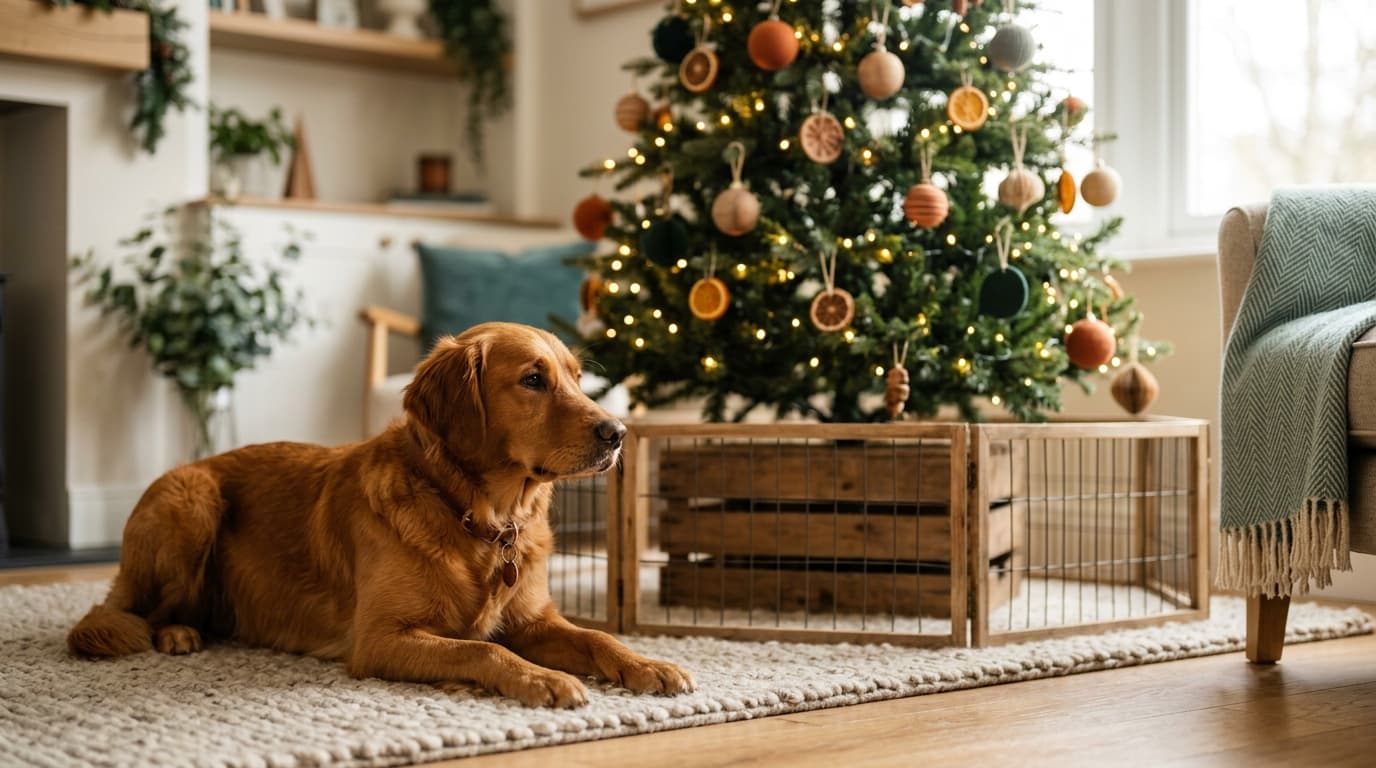
The Annual Battle: Dogs vs. Christmas Trees
Every December, the same scene plays out in millions of homes. You spend an hour decorating a beautiful tree. You turn your back for five minutes. Suddenly, your dog has knocked it over, eaten an ornament, or started drinking the tree water. It's practically a holiday tradition at this point.
During my five years working as a vet tech in Portland, December was just a parade of dogs who had gotten into holiday decorations. The good news is you can have both a beautifully decorated tree and an intact dog. These 12 tips come from my clinic days, plus plenty of trial and error at home. Between Benny, my 9-year-old lab/pit mix with a heavy tail, and Maple, my 2-year-old Australian shepherd who views all dangling objects as a challenge, I've had to lock my setup down entirely.
Tip 1: Anchor Your Tree to the Wall
This is the single most important step if your dog bumps into things. Benny's hip dysplasia makes him a bit clumsy these days. His tail wags are a genuine structural threat. I use a wall anchor (or a ceiling hook) with heavy-duty fishing line tied around the tree trunk. It's invisible from across the room. More importantly, it prevents the absolute worst-case scenario: a fully decorated tree crashing down onto your dog.
If anchoring isn't an option, buy a heavy-duty tree stand with a massive base. I tested the Krinner Tree Genie XXL against the flimsy stands bundled with artificial trees. The cheap ones are a joke. The Krinner holds up beautifully, even after a direct hit from Benny.
Tip 2: Choose Your Tree Location Strategically
Place your tree in a corner. Two walls provide natural barriers. You want to avoid high-traffic areas where your dog normally does zoomies. If possible, pick a room with a door you can close when you aren't home.
Corner placement also makes that wall-anchoring trick I just mentioned much easier. It completely limits the angles your dog can use to approach the tree.
Tip 3: Skip the Bottom Third of Ornaments
Don't hang ornaments on the lower branches. Maple is perfectly at eye-level with the bottom branches. I leave the bottom third completely bare. You can use ribbon or garland instead. From a standing human's perspective, the tree still looks entirely full. Plus, your dog can't reach anything breakable with their mouth or tail.
Tip 4: Use Shatterproof Ornaments
Replace your glass ornaments with plastic, fabric, or wood. (At least on the lower two-thirds of the tree.) If a plastic ornament falls, it bounces. If a glass one falls, it shatters into microscopic shards. During my vet tech days, I spent hours digging broken glass out of paw pads. The math is simple.
Save your fragile, sentimental glass pieces for the very top branches. Keep them well out of reach.
Tip 5: Manage Cords and Lights Carefully
Electrical cords are a massive chewing hazard, especially for puppies. Run your cords behind heavy furniture. Alternatively, use thick cord covers. I always plug my tree lights into a power strip so I can quickly flip the switch off when I leave the room. Here's the thing: battery-operated LED lights are an even safer bet. They eliminate the electrical risk entirely.
Check your cords after two weeks of the season. A chewed cord with exposed wire is a shock and fire hazard waiting to happen.
Tip 6: Block Tree Water Access
Stagnant tree water is a health hazard. It's full of fertilizer, pesticide residue, and bacteria. Some commercial tree preservatives even contain aspirin. That's highly toxic to dogs. Even plain water turns into a bacterial soup after sitting in a warm room for days.
I use a covered tree stand. A simple sheet of aluminum foil over the water reservoir also works in a pinch. A standard fabric tree skirt won't stop a determined dog from taking a drink.
Tip 7: Use a Baby Gate or Exercise Pen
For dogs that absolutely can't leave the tree alone, a physical barrier is the most reliable solution. I used a metal MidWest exercise pen wrapped completely around the tree during Maple's first Christmas. It creates an undeniable boundary.
I'd skip this if you have an older, mellow dog who ignores the decorations. But for puppies who lack impulse control? It's entirely worth it.
Tip 8: Apply Bitter Apple Spray to Low Branches
Bitter apple spray is a non-toxic deterrent that tastes terrible to dogs. I spray it directly on the lower branches, the tree skirt, and the trunk base.
The honest downside is that it wears off fast. You have to reapply it every few days. Also, some dogs will just power through the bad taste anyway. It's not a standalone fix. (I've seen dogs at the Multnomah County Animal Shelter happily lick bitter apple spray off the bars.) But it adds a helpful layer of discouragement.
Tip 9: Remove Toxic Plants from the Room
Holiday plants are notorious in veterinary medicine. Here's what I dealt with constantly at the clinic:
- Mistletoe -- Causes gastrointestinal upset, cardiovascular problems, and sometimes seizures.
- Holly berries -- Triggers severe vomiting, diarrhea, and lethargy.
- Poinsettias -- Mildly toxic. They cause mouth and stomach irritation. (They aren't as lethal as people think, but keep them away anyway.)
- Amaryllis -- Causes vomiting, diarrhea, abdominal pain, and tremors.
- Pine needles -- Can physically puncture the intestinal lining if your dog eats enough of them.
Keep these out of reach. Better yet, stick to the fake versions. It's much less stressful.
Tip 10: Train a "Leave It" and "Place" Command
If your dog doesn't have a reliable "leave it" command, start training it well before December. I use high-value treats. This teaches my dogs that ignoring the tree pays better than investigating it.
A solid "place" command (going to a specific bed or mat) is equally important. Dogs do much better when you tell them what to do, rather than just yelling at them for what they shouldn't do.
Tip 11: Supervise or Separate
The rule in my house is simple. If I can't actively watch the dogs, they don't get access to the tree room. I close the door, use a baby gate, or crate them when I leave the house or go to sleep.
Most tree disasters happen when nobody is looking. The ten minutes you spend in the shower or the thirty minutes you're out grocery shopping are prime incident windows.
Tip 12: Provide Alternative Enrichment
Dogs usually fixate on the Christmas tree because it's the most novel thing in the room. You have to compete with it. What sealed it for me with Maple was giving her a frozen stuffed Kong every night I sat by the tree.
Give them puzzle toys or a long-lasting chew. I keep track of durability on a spreadsheet, and the West Paw Toppl is my current favorite for distracting power chewers. If your dog is busy working on something delicious, the tree fades into the background. (Even six months in, Maple still treats a frozen Toppl like the greatest thing on earth.) Rotate these chews out to keep the novelty high.
What to Do If Your Dog Eats an Ornament
Does your dog get anxious during the holidays? Our Dog Anxiety Relief Kit helps manage seasonal stress with calming aids and enrichment.
Despite your best efforts, things go wrong. If your dog eats an ornament, ribbon, tinsel, or any foreign object, here's exactly what to do:
- Don't induce vomiting unless a vet specifically instructs you to. Sharp glass or hard plastic can shred an esophagus coming back up.
- Call your vet or the ASPCA Animal Poison Control Center (888-426-4435) immediately.
- Watch for obstruction symptoms: Vomiting, lethargy, loss of appetite, straining to poop, or abdominal pain.
- Tinsel and ribbon are an emergency. I've seen enough linear foreign bodies in the vet clinic to know. They bunch up and saw through the intestines. This requires major surgery.
The Bottom Line
Dog-proofing your tree isn't about sacrificing your holiday joy for pet safety. With a simple wall anchor, smart ornament placement, and basic cord management, the tree and the dogs can coexist beautifully. That thirty minutes of prep work holds up all season long. It's entirely worth it to avoid a panicked trip to the emergency vet on Christmas Eve.
Start with the anchor and the baby gate. Build your strategy from there. And if all else fails, an artificial tabletop tree on a high surface is a perfectly dignified backup plan.
Related Reading
- Holiday Safety Tips for Dogs -- Complete seasonal safety guide
- Best Dog Advent Calendars -- Include your dog in the fun safely
- Dog Separation Anxiety Guide -- When holiday stress triggers panic