
Affiliate Disclosure: This post contains Amazon affiliate links. I earn a small commission at no extra cost to you.
Why Crate Training Matters for Adult Dogs
Most people associate crate training with puppies. But adult dogs benefit from crates just as much, sometimes more. A crate provides a safe space during thunderstorms. It prevents destructive behavior when you're away. It keeps your dog secure during car travel and vet recovery. And if your dog ever needs to be boarded or hospitalized, prior crate training dramatically reduces their stress.
When I worked as a vet tech in Portland, the dogs who struggled most during overnight stays were the ones who had never been in a crate. They would panic, injure themselves, and refuse to eat. The dogs with positive crate associations settled down quickly. I adopted Benny, my 9-year-old lab/pit mix, from the Multnomah County Animal Shelter when he was three. He had never seen a crate. Training him took patience, but today his crate is his favorite place in the house.
Before You Start: Get the Right Gear
The wrong equipment makes crate training harder than it needs to be. Here's what you need.
The Crate
Size matters. Your dog should be able to stand up fully, turn around, and lie down stretched out. Too big and the crate loses its den-like feel. Too small and your dog is physically uncomfortable. For most medium-to-large adults, I recommend the MidWest iCrate. It's what trainers have recommended for years. The double-door design gives you flexibility, and the fold-flat construction makes it portable.
For larger breeds (up to 110 pounds), the MidWest iCrate 48-inch XL is the right size.
Buy MidWest iCrate 48-inch XL on Amazon
The Treats
You need high-value treats for this process. Standard kibble won't cut it. Zuke's Mini Naturals are small, low-calorie, and highly motivating. They're perfect for repetitive reward sessions where you'll go through a lot of treats quickly.
Buy Zuke's Mini Naturals on Amazon
The Enrichment
A stuffed KONG is your best friend during crate training. Fill a KONG Classic with peanut butter or wet food and freeze it overnight. This gives your dog something amazing to work on inside the crate, building a powerful positive association.
For Anxious Dogs
If your dog shows signs of anxiety (panting, drooling, whining that escalates rather than settles), a calming supplement can take the edge off while you work through the training process. The ThunderShirt applies gentle, constant pressure that calms most dogs during stressful situations.
Buy ThunderShirt Classic on Amazon
Adaptil pheromone diffusers release calming pheromones that mimic a nursing mother. Place one near the crate to create a calming environment.
Buy Adaptil Calming Diffuser on Amazon
The Step-by-Step Process
This process takes 2-4 weeks for most adult dogs. Some dogs take longer. Rushing it is the single biggest mistake people make.
Week 1: Introduction (Days 1-7)
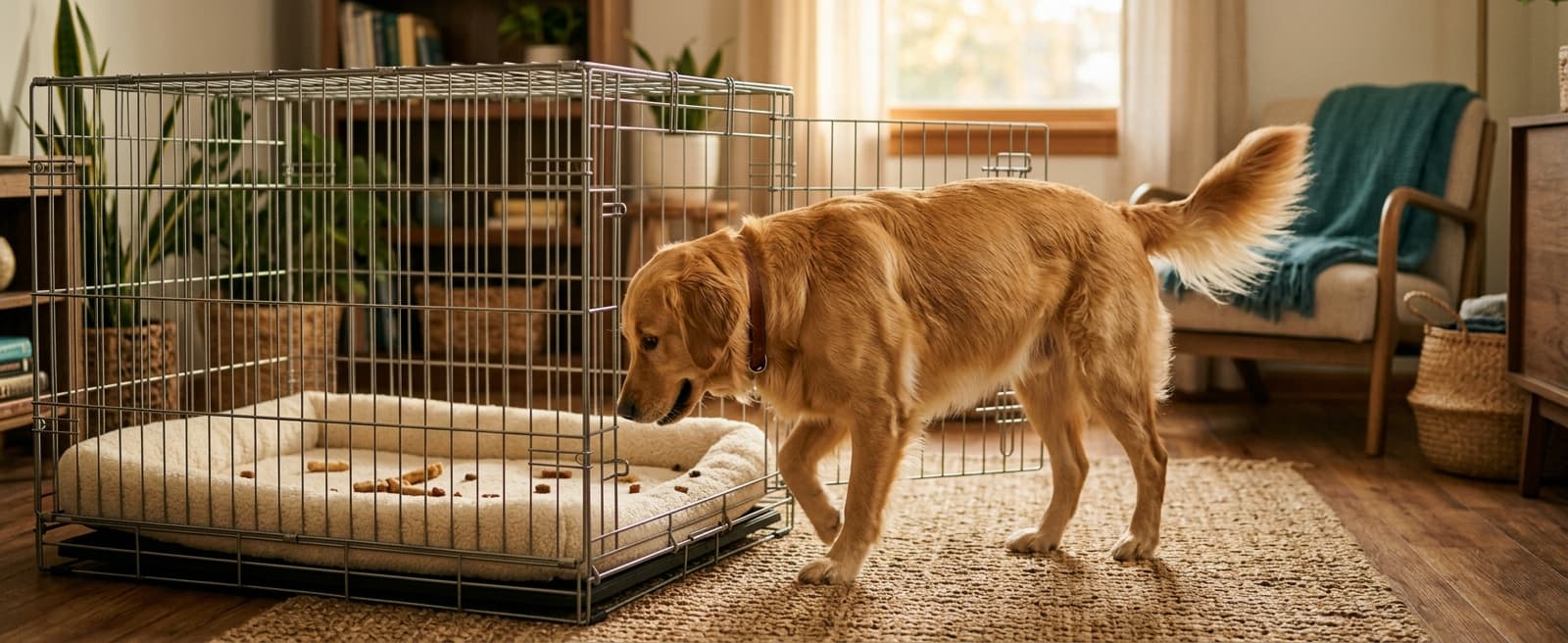
Day 1-2: The crate exists, nothing else. Place the crate in a common area with the door removed or tied open. Put a comfortable pad inside. Toss a few treats near the crate opening. Do nothing else. Let your dog investigate on their own timeline. If they go inside, great. If they don't, that's fine too. No luring, no pushing, no forcing.
Day 3-4: Feeding near the crate. Place your dog's food bowl next to the crate, then gradually move it just inside the door opening over these two days. Your dog should eat comfortably near and then just inside the crate. Door stays open.
Day 5-7: Feeding inside the crate. Move the bowl to the back of the crate. Your dog goes all the way in to eat. The door stays open the entire time. After meals, toss a frozen KONG inside and walk away. Let your dog choose to stay and work on it.
Week 2: Door Introduction (Days 8-14)
Day 8-9: Close the door briefly. While your dog eats or works on a KONG inside the crate, gently close the door. Open it immediately after they finish. No latching. The goal is door closure becoming a non-event.
Day 10-11: Closed door for 1-5 minutes. Latch the door while your dog has a frozen KONG. Sit nearby and read a book. Open the door after 1-5 minutes, before your dog shows any anxiety. Always open the door while they're still calm.
Day 12-14: Closed door for 10-30 minutes. Gradually increase the duration. Stay in the same room but reduce your attention to the crate. If your dog whines, wait for 3-5 seconds of silence before opening the door. Never open the door in response to whining, or you teach them that whining works.
Week 3: Building Duration (Days 15-21)
Day 15-17: 30 minutes to 1 hour, you're home. Your dog is in the crate with a frozen KONG. You move around the house normally. Come and go from the room. The crate becomes background, not an event.
Day 18-19: Short departures. Crate your dog, give them a frozen KONG, and leave the house for 15-30 minutes. Return calmly. No big reunion. Let your dog out quietly.
Day 20-21: Longer departures. Extend to 1-2 hours. Always leave a frozen KONG or enrichment toy. Return calmly.
Week 4: Real-World Use (Days 22-28)
Build up to the duration you actually need. Most adult dogs can comfortably handle 4-6 hours in a crate. Eight hours is the absolute maximum for a healthy adult, and only if they've been exercised beforehand.
Common Mistakes to Avoid
Using the crate as punishment. Never put your dog in the crate when you're angry. The crate must always be associated with good things.
Going too fast. If your dog shows signs of distress, you've jumped ahead too quickly. Back up to the last step where they were comfortable and spend more time there.
Leaving them too long. An adult dog shouldn't spend more than 8 hours in a crate. If you work long hours, consider a dog walker or doggy daycare for the midday break.
No enrichment. A bare crate with nothing to do creates boredom and frustration. Always provide a frozen KONG or enrichment toy.
When to Seek Professional Help
If your dog shows extreme anxiety in the crate (screaming, self-injury, breaking out, urinating or defecating despite being house-trained), you may be dealing with separation anxiety. This is a clinical condition that requires professional intervention. A certified veterinary behaviorist can develop a treatment plan that may include medication alongside behavioral modification.
I see this distinction missed constantly. Normal adjustment whining stops within 10-15 minutes and decreases over days. Separation anxiety escalates and does not improve with basic training alone.
Setting Up Your Crate Space
Living in an apartment? Our Apartment Dog Essentials Kit pairs the right crate setup with noise management and enrichment tools designed for smaller living spaces.
Place the crate in a room where your family spends time. Dogs are social animals. Putting the crate in a dark basement or unused room undermines the whole process. The crate should feel like your dog's spot in the family room, not solitary confinement.
Cover three sides of the crate with a blanket to create a den-like atmosphere. Leave the front open so your dog can see the room.
Try our free tool: Crate Size Finder -- find the right crate dimensions for your dog's breed and weight.
Final Thoughts
Looking for breed-specific crate picks? See our best dog crates for German Shepherds.
Crate training an adult dog takes patience. Some dogs take to it in a week. Others need a month or more. Benny needed three full weeks before he willingly went into his crate without a treat lure. Now he puts himself to bed in it every night. The investment of time is worth it. A crate-trained dog is safer, calmer, and easier to manage in every situation that life throws at you.
Related Reading
- Best Dog Crate Pads and Mats 2026 -- Comfortable crate bedding picks
- How to Choose Dog Crate Size -- Get the right dimensions
- Dog Anxiety: The Complete Guide -- When crate stress is actually anxiety