
Affiliate Disclosure: This post contains Amazon affiliate links. I earn a small commission at no extra cost to you.
What Dog Anxiety Actually Looks Like
Most people think dog anxiety means shaking during thunderstorms. That's one type. But anxiety in dogs presents in dozens of ways that owners miss entirely. Destructive behavior when left alone. Excessive licking that creates raw spots. Pacing. Panting when it's not hot. Refusing to eat. Sudden aggression. Hiding. Diarrhea before car rides. These are all potential anxiety signals.
When I worked as a vet tech at a mixed-practice clinic in Portland, anxiety-related cases made up easily 30 percent of our behavioral consultations. Most owners came in thinking their dog was "being bad" or "stubborn." They weren't. They were anxious. Understanding the difference changes everything about how you approach the problem.
My 9-year-old lab/pit mix, Benny, has noise anxiety. Fireworks, thunder, and construction sounds all trigger him. Managing his anxiety has been a years-long process involving environmental changes, calming products, and veterinary guidance.
The Three Types of Dog Anxiety
1. Separation Anxiety
This is the most common form. Your dog panics when left alone. Signs include destructive behavior focused on exits (chewing door frames, scratching at windows), vocalizing (howling, barking) that starts within minutes of your departure, house soiling despite being fully house-trained, and excessive salivation. Some dogs injure themselves trying to escape.
Separation anxiety is a clinical condition, not a behavior problem. The distinction matters because behavior problems respond to training alone. Separation anxiety often requires a combination of behavioral modification, environmental management, and sometimes medication.
2. Noise Anxiety
Thunderstorms, fireworks, construction, gunshots, vacuum cleaners, smoke detectors. Noise anxiety triggers a fight-or-flight response. Dogs may hide, tremble, pant, pace, try to escape, or become destructive. Benny's noise anxiety started at age five and has gotten worse with age, which is typical. Noise anxiety tends to generalize over time, meaning dogs become sensitive to an expanding range of sounds.
3. Generalized Anxiety
Some dogs are anxious about everything. New environments, strangers, other dogs, novel objects, car rides, vet visits. This is often rooted in insufficient socialization during the critical 3-16 week puppy window, traumatic experiences, or genetic predisposition. Breeds like German Shepherds, Border Collies, and Australian Shepherds are statistically more prone.
How to Identify Anxiety in Your Dog
Anxiety signals range from subtle to obvious. Here's what to watch for:
Subtle signs (often missed):
- Lip licking when no food is present
- Yawning when not tired
- Whale eye (showing the whites of the eyes)
- Turning away or avoiding eye contact
- Ears pinned back
- Tucked tail
- Paw lifting
Moderate signs:
- Panting when it's not hot
- Pacing or inability to settle
- Excessive drooling
- Decreased appetite
- Following you from room to room
- Whining
Severe signs:
- Destructive behavior
- House soiling in a trained dog
- Self-injury (chewing paws, licking to raw spots)
- Aggression
- Attempting to escape
- Prolonged howling or barking when alone
Products That Actually Help
I've tested dozens of anxiety products. Here are the ones that deliver real results.
Pressure Wraps
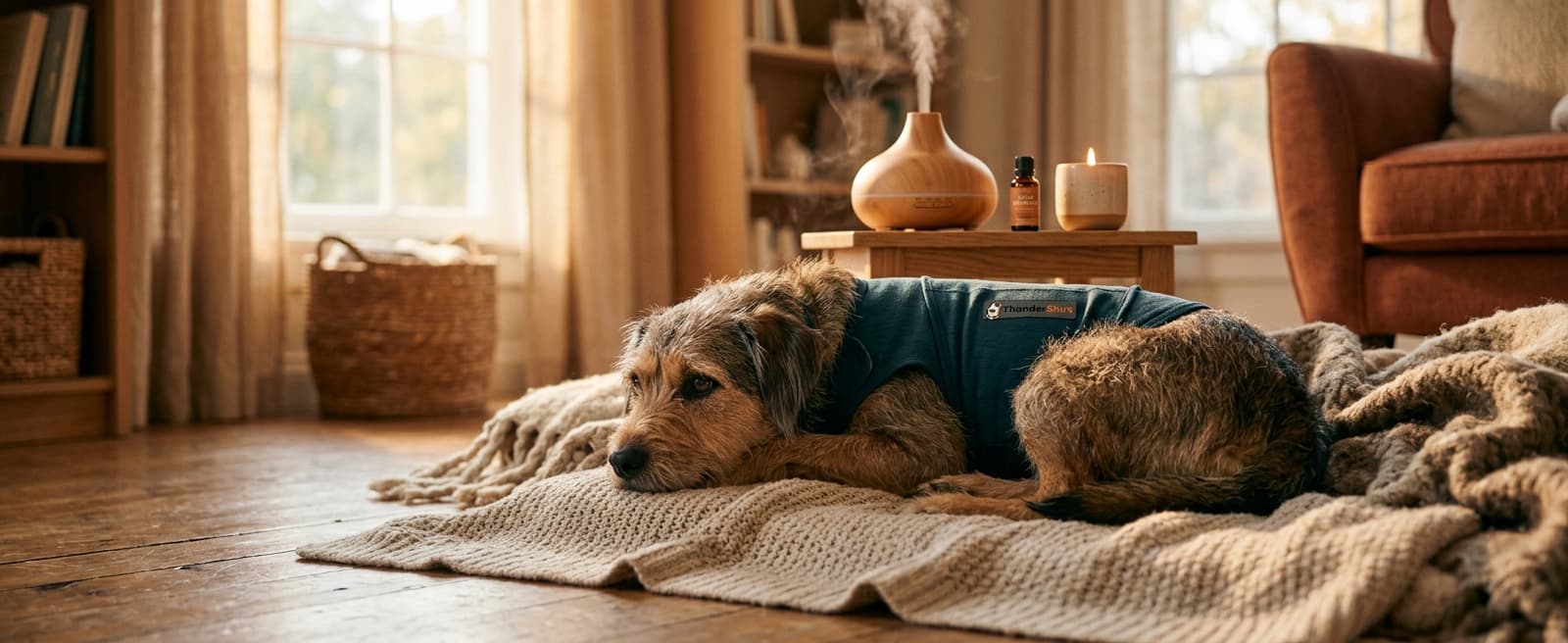
The ThunderShirt applies gentle, constant pressure that calms most dogs during storms, fireworks, and travel. The mechanism is similar to swaddling an infant. Research shows it works for roughly 80 percent of dogs. I use one on Benny during every thunderstorm. The effect is noticeable within minutes.
Buy ThunderShirt Classic on Amazon
Pheromone Therapy
Adaptil releases dog-appeasing pheromones that mimic a nursing mother. These pheromones signal safety and comfort. The plug-in diffuser covers about 700 square feet and runs continuously. I keep one near Benny's crate year-round. The research behind Adaptil is solid and clinically validated.
Buy Adaptil Calming Pheromone Diffuser on Amazon
Calming Supplements
Zesty Paws Calming Bites combine Suntheanine (an amino acid that promotes relaxation), chamomile, and organic hemp in a turkey-flavored soft chew. They promote relaxation without causing drowsiness. I give these to Benny 30 minutes before predicted thunderstorms.
Buy Zesty Paws Calming Bites on Amazon
VetriScience Composure Pro uses clinically tested Colostrum Calming Complex, L-theanine, and thiamine. This is the supplement most veterinary behaviorists I know recommend first.
Buy VetriScience Composure Pro on Amazon
NaturVet Quiet Moments uses melatonin, thiamine, and L-tryptophan. It's effective for mild anxiety and is one of the more affordable supplement options.
Buy NaturVet Quiet Moments on Amazon
Enrichment Tools
A frozen KONG is one of the most effective anxiety management tools available. Fill it with peanut butter or wet food, freeze it overnight, and give it to your dog before a predicted anxiety trigger. The focused licking releases calming endorphins and provides distraction.
LickiMats serve a similar purpose. Spread peanut butter on the textured surface for repetitive, calming licking behavior. I use these at the shelter during nail trims and first vet visits.
Buy LickiMat Classic Soother on Amazon
Safe Spaces
The Best Friends by Sheri Calming Donut Bed provides a nest-like environment with raised edges. Anxious dogs instinctively seek enclosed spaces. The deep-dish design and faux fur surface mimic being held.
Buy Best Friends by Sheri Calming Donut Bed on Amazon
Monitoring
A dog camera lets you observe your dog's behavior when you're away, which is critical for diagnosing separation anxiety. Many owners don't realize how distressed their dog becomes because the behavior stops the moment they return.
A Practical Anxiety Management Plan
Looking for a curated set of anxiety products? Our Dog Anxiety Relief Kit bundles the most effective tools together.
Step 1: Identify the trigger
Keep a log for two weeks. Record when your dog shows anxiety signs, what was happening at the time, and how severe the response was. Patterns will emerge.
Step 2: Environmental management
Remove or reduce triggers where possible. Close curtains during fireworks. Play white noise during thunderstorms. Create a safe room with a crate, calming bed, and Adaptil diffuser. Give your dog access to this space at all times.
Step 3: Start with the simplest interventions
Begin with a ThunderShirt and calming supplement before jumping to prescription medication. For many dogs, these tools combined with environmental management are enough.
Step 4: Desensitization and counter-conditioning
This is the long-term solution. Expose your dog to a very mild version of their trigger while pairing it with something amazing (high-value treats, a frozen KONG). Gradually increase the intensity over weeks and months. This rewires your dog's emotional response to the trigger.
For noise anxiety, play recordings of storms or fireworks at barely audible volume while your dog eats dinner. Over weeks, gradually increase the volume. Never increase faster than your dog can handle without showing stress.
Step 5: Know when to escalate
If your dog's anxiety is severe, causing self-injury, or not responding to the steps above after 4-6 weeks of consistent effort, consult a veterinary behaviorist. Prescription medications like fluoxetine, trazodone, or gabapentin can be game-changers when combined with behavioral modification. Medication is not a failure. It's a tool, just like a ThunderShirt.
What Doesn't Work
Punishment. Punishing an anxious dog makes the anxiety worse. Every single time. Do not yell at, crate as punishment, or physically correct an anxious dog.
"Toughing it out." Forcing an anxious dog to endure their trigger (flooding) can create trauma and worsen the condition permanently.
CBD products without evidence. The CBD pet market is poorly regulated. Most products have not been tested for safety or efficacy in dogs. Talk to your vet before using CBD.
Ignoring it. Anxiety does not resolve on its own. It almost always gets worse over time without intervention.
When Anxiety Becomes an Emergency
If your dog injures themselves during an anxiety episode (broken teeth from crate escape attempts, bleeding paws from scratching at doors, lacerations from breaking through windows), that's a veterinary emergency. Stabilize the injury, then schedule a behavioral consultation immediately. These dogs typically need prescription anti-anxiety medication.
Try our free tool: Anxiety Trigger Tracker -- log your dog's anxiety episodes and identify patterns.
Final Thoughts
Looking for breed-specific anxiety management? See our best dog anxiety relief for German Shepherds.
Anxiety is not your dog being dramatic or manipulative. It's a genuine emotional and physiological response. The good news is that most anxiety is manageable with the right combination of environmental changes, calming products, and behavioral work. Start with the simplest tools, be patient, and don't hesitate to involve your vet when needed. Benny's anxiety isn't cured, but it's managed. He sleeps through most storms now. That's a win I'll take.
Related Reading
- Dog Enrichment Activities -- Mental stimulation that reduces anxiety
- How to Crate Train an Adult Dog -- Creating a safe crate space
- Best Dog Cameras 2026 -- Monitor your dog when you're away