
Affiliate Disclosure: Some links in this article are Amazon affiliate links. We earn a small commission if you purchase through them.
Why Most Dogs Pull on the Leash
During my five years as a vet tech at a mixed-practice clinic in Portland, I saw plenty of owners with wrenched shoulders. Let's clear something up right away. Your dog isn't pulling because they're dominant, stubborn, or trying to be the "alpha." They pull because walking is exciting. The world smells interesting. And, frankly, pulling works. Every time they drag you and you follow, they learn that tension equals forward progress.
When I brought Maple home, my 2-year-old Australian shepherd, she walked like a sled dog. It took us exactly three weeks of daily practice to break the habit. The good news? This is completely fixable with the right approach and strict consistency.
What You'll Need
Before starting, make sure you have the right gear. I've logged over 600 dog products in my testing spreadsheet since 2019. You only really need a few basics:
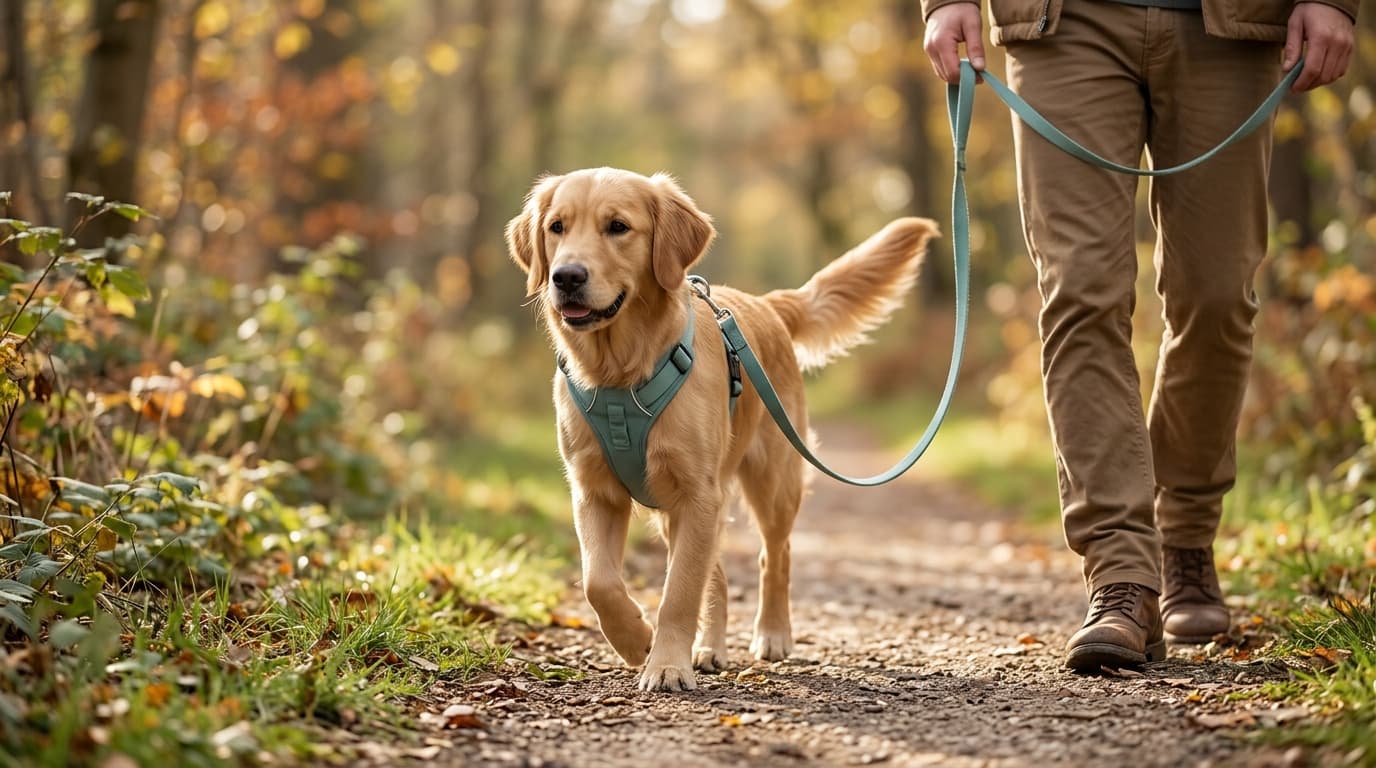
- A front-clip harness like the PetSafe Easy Walk or Ruffwear Front Range — these redirect your dog's momentum when they pull. (I use the Ruffwear for Maple's high-energy hikes. It holds up beautifully against power chewers and heavy pullers).
- High-value training treats like Zuke's Mini Naturals — small, smelly, and easy to chew quickly. (Compared to crunchy biscuits, these won't break your dog's walking stride).
- A treat pouch like the PetSafe Sport Pouch — keeps treats accessible for quick rewards.
- A 6-foot leash (I'd skip anything retractable. The constant spring tension trains your dog to pull by default).
The Foundation: Indoor Leash Training
Start indoors. The living room has fewer distractions than the sidewalk.
Step 1: Teach "Look at Me"
Hold a treat near your face and say "look" or "watch me." The second your dog makes eye contact, mark it (click or say "yes!") and deliver the treat. Practice this 20 times before moving on. I still do this with Benny, my 9-year-old lab/pit mix. It keeps his focus sharp without stressing his hip dysplasia.
Step 2: Reward the Position
With your dog on leash, reward them every time they stand next to you with a loose leash. Don't ask for a sit or stay. Just reward the position. You're teaching them that being right beside your leg is a highly profitable place to hang out.
Step 3: Take Indoor Walks
Walk around your house with your dog on leash. Every three to five steps, reward them for staying beside you. If they pull ahead, stop moving completely. Wait for them to look back at you. When they return to your side, reward and continue.
Moving Outdoors: The Real Challenge
Once your dog can walk nicely indoors, it's time for the driveway.
Try our free tool: Leash Length Guide -- find the ideal leash length for your training stage and activity.
The "Be a Tree" Method
When your dog pulls, stop moving immediately. Don't yank the leash. Just plant your feet. Wait for any of these:
- Your dog looks back at you
- The leash goes slack
- Your dog takes a step toward you
The moment any of these happen, mark and reward, then resume walking. The honest downside? Your first few outdoor walks will be painfully slow. You might only make it to the mailbox. That's perfectly normal.
The "Penalty Yards" Method
When your dog pulls toward a specific smell or dog, turn around and walk the other way. This teaches them that pulling actually moves them further from what they want. When they catch up and the leash goes slack, turn back toward the original direction. I use this constantly with the power-pullers I volunteer with at the Multnomah County Animal Shelter.
The "300 Peck" Method
This is a highly structured approach. (It's tedious, but worth it if your dog ignores the other methods). Here's how it works:
- Take one step. If your dog stays beside you, reward.
- Take two steps. Reward.
- Take three steps. Reward.
- Continue increasing by one step each time.
- If your dog pulls at any point, reset and go back to one step.
Common Mistakes to Avoid
Putting together your training toolkit? Our Dog Training Toolkit bundles front-clip harnesses, treat pouches, clickers, and high-value treats.
- Inconsistency — If you let your dog pull sometimes, you're just teaching them to always try their luck.
- Using a retractable leash — These reward pulling by giving the dog more line. Skip them.
- Starting in high-distraction areas — Don't take a leash-training puppy straight to a busy dog park.
- Training when frustrated — Both you and your dog should be in a calm state of mind. If you're annoyed, pack it up.
- Too-long sessions — Keep training walks to 10 or 15 minutes. Switch to a standard harness attachment for their regular exercise walk.
The Timeline: What to Expect
Here's the thing. Every dog learns at their own pace. But after tracking hundreds of training cases, this is the general progression I see:
- Week 1-2: Indoor leash training. Five to 10 minutes, two or three times daily.
- Week 2-3: Short outdoor walks in low-distraction areas. You'll go through a lot of treats.
- Week 3-4: Gradually increase distance and add mild distractions.
- Month 2-3: Most dogs show significant improvement around the eight-week mark. You can start reducing treat frequency.
- Month 3+: Maintenance mode. Occasional treats keep the good behavior sharp.
The Bottom Line
Looking for breed-specific harness picks for leash training? See our best dog harnesses for Labrador Retrievers.
Leash training isn't complicated. It just requires patience and stubborn consistency. What sealed it for me was adopting this single, non-negotiable rule: never move forward when the leash is tight. If you commit to this one principle, your dog will learn that a loose leash means forward movement. Pulling means nothing happens. It really is that simple.
Check out our 30-Day Leash Training Blueprint for a printable daily training schedule.
Related Reading
- Best Dog Harnesses 2026 -- The right harness makes training easier
- Stop Your Dog From Jumping -- Another common behavior fix
- How to Socialize Your Puppy -- Leash skills are part of socialization