
When I worked as a vet tech at a mixed-practice clinic in Portland, I fielded more questions about jumping than almost any other behavior. People came in with scratched arms and muddy clothes. They wanted a quick fix.
I've personally tested over 600 dog products since 2019 (I keep a massive spreadsheet for these things), and here's the thing. There's no magic anti-jumping harness. But you can fix this entirely with positive methods. I did it with Maple, my 2-year-old Australian shepherd. She used to treat every visitor like a human trampoline.
Why Dogs Jump on People
Before you fix the behavior, you've got to understand the motivation. Dogs launch themselves at us for a few predictable reasons:
Greeting behavior. Puppies lick their mother's mouth to say hello. When your dog jumps, they're just trying to reach your face. It's standard dog communication.
It works. Every time someone pushes, pets, or yells at a jumping dog, the dog wins. They wanted attention. You gave it to them. From the dog's perspective, this strategy holds up.
Excitement overflow. Some dogs simply can't contain themselves. Maple used to vibrate with energy when guests arrived. High-energy breeds constantly struggle with impulse control.
Reinforcement history. If you let your dog jump when they were a puppy (because it was cute when they weighed ten pounds), they practiced it. Now they weigh sixty pounds. The habit is fully baked in.
The Golden Rule: Stop Reinforcing It
This is the hardest part. Jumping must never result in attention again. Not positive attention. Not negative attention. Nothing.
This means:
- No petting when they jump.
- No pushing them down (that's physical contact, which is a reward).
- No shouting "down" or "off" (that's verbal attention).
- No eye contact.
The moment those front paws leave the ground, you become a statue. Turn slightly away. Fold your arms. Look at the ceiling. You're boring. You're invisible.
Teach "Four on the Floor"
Don't just punish the mistake. Give your dog a clear job instead. You want all four paws grounded.
Step 1: Capture Calmness
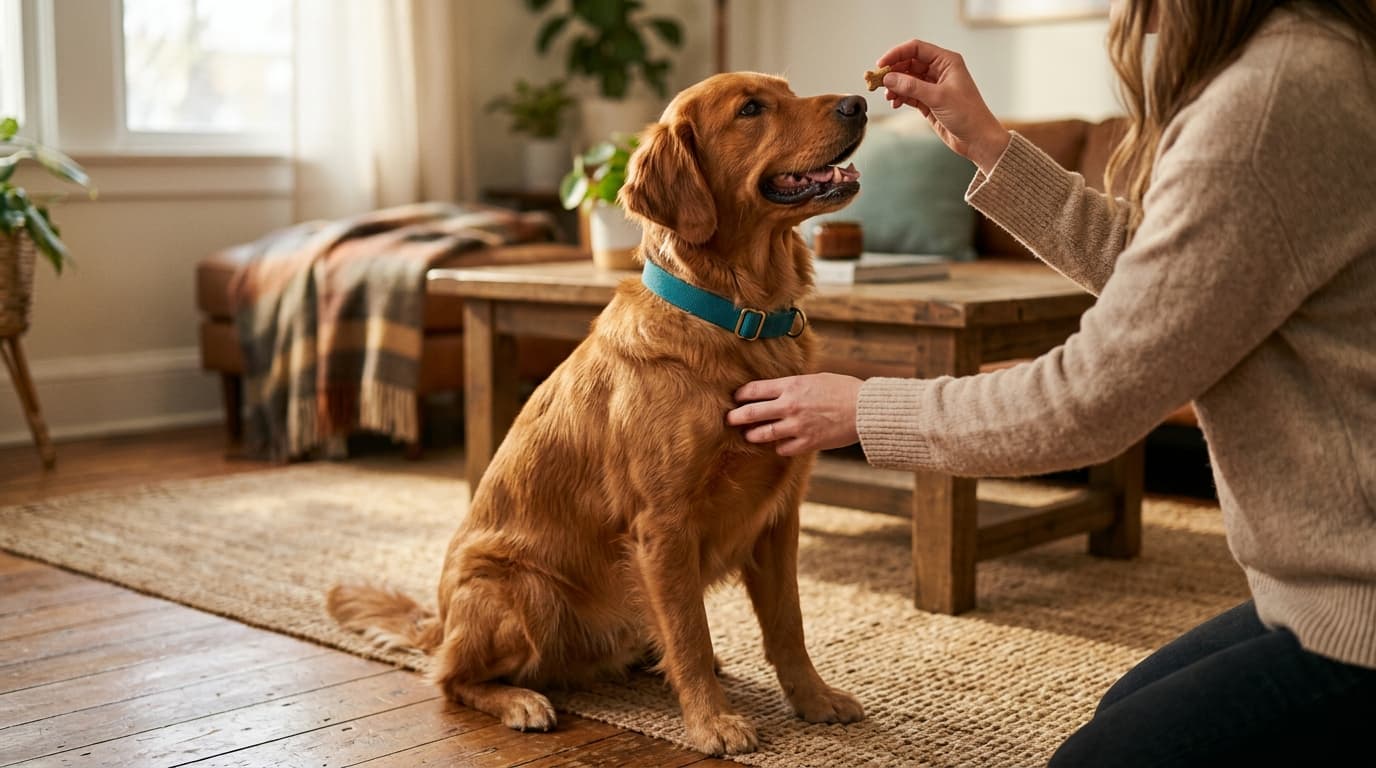
Grab some treats. Stand in a quiet room with your dog. The second all four paws are on the floor and they look at you, mark it with a "yes." Deliver the treat at floor level. I did this with Maple for five-minute stretches. After two weeks, her default state became standing entirely still.
Step 2: Add the Door Trigger
Most jumping happens at the front door. Practice approaching your door from the inside. Walk toward it. Turn around. If your dog stays grounded, mark and treat. If they jump, become a statue until they settle.
Step 3: Practice With a Helper
Recruit a friend. Tell them the rules beforehand. If the dog jumps, your friend turns away silently. If the paws stay down, your friend calmly says hello and drops a treat. Do this five to ten times per session.
Step 4: Practice in Real Scenarios
Real life's messier. Keep a treat pouch by the door. Ask actual guests to wait a second when they arrive. Get your dog's focus. Reward them heavily for keeping their feet planted.
Train an Incompatible Behavior
A dog can't sit and jump at the same time. Teaching a reliable "sit for greeting" solves the problem entirely. What sealed it for me was realizing Maple needed a specific physical task to override her jumping instincts.
How to Train Sit for Greeting
- Build a strong sit. Practice in boring environments. You want an immediate response.
- Add distance. Have your helper stand fifteen feet away. Ask your dog to sit. Reward it. The helper takes one step forward. If the dog stays sitting, reward again. If they break the sit, the helper steps back.
- Close the gap. Over several sessions, let the helper walk all the way up. They can pet the dog as long as the sit holds.
- Generalize. Take this on the road. Practice at the park, outside the pet store, and with strangers.
Management: Setting Your Dog Up to Succeed
Putting together your training toolkit? Our Dog Training Toolkit bundles treat pouches, clickers, and training guides.
You can't train 24/7. Use management tools to stop the rehearsing of bad habits while you're still working on them.
- Leash at the door. Step on the leash when guests arrive. Give them just enough slack to stand, but not enough to jump.
- Baby gates. I'd skip this if your dog is an athlete who clears gates easily, but it works for most. Let them watch guests arrive from a distance.
- Place command. Benny, my 9-year-old lab/pit mix, goes straight to his orthopedic bed when the doorbell rings. He's my senior-gear expert, but he still needs boundaries. Reward heavily for staying put.
- Exercise first. A tired dog makes better choices. A twenty-minute walk before hosting a party changes everything.
The Extinction Burst: It Gets Worse Before It Gets Better
The honest downside of positive training is the extinction burst. When you stop rewarding the jumping, your dog will try harder. They'll jump higher. They'll scramble frantically.
Maple turned into a complete kangaroo around day four. She was essentially saying, "This used to work! Let me try harder!"
Stay the course. If you cave during an extinction burst, you just taught them that persistence pays off. The behavior becomes practically permanent after that.
Common Mistakes to Avoid
Inconsistency. If your partner lets the dog jump but you don't, the dog will keep gambling. Everyone in the house has to be on board.
Kneeing the dog. People used to tell you to lift your knee into the dog's chest. Don't do this. When I worked at the clinic, we saw bruised ribs from this exact method. It damages your relationship and doesn't teach them what to do instead.
Only training during greetings. Practice your sits and "four on the floor" all day long. Waiting for actual guests doesn't give you enough repetitions.
Expecting overnight results. You're fighting months or years of muscle memory. Six months in, you'll wonder why you didn't start sooner. Be patient.
Timeline: What to Expect
- Week 1-2: The extinction burst. The jumping might actually get worse.
- Week 2-4: You'll see faster recovery times. They'll hit the floor sooner.
- Month 2-3: Most dogs default to sitting or standing when people approach.
- Ongoing: You'll need occasional refreshers. High-energy environments always test their limits.
When to Get Professional Help
I volunteer monthly at the Multnomah County Animal Shelter. I see plenty of dogs who jump out of sheer anxiety. Watch their body language. If the jumping pairs with growling, stiff posture, or nervous peeing, you aren't just dealing with excitement. You're dealing with fear.
If you've been strict with these methods for eight weeks without progress, find a certified professional dog trainer (CPDT-KA) or a vet behaviorist. Anxiety requires a totally different playbook.
The Bottom Line
Jumping's entirely natural. It isn't dominance. It isn't disrespect. Your dog's just using a strategy that worked in the past.
Remove the payoff. Reward the calm behavior. It requires an annoying amount of patience (and a willingness to look like a statue). But getting your guests through the door without a wrestling match is definitely worth it.
Related Reading
- Leash Training Tips -- Another common behavior to master
- How to Socialize Your Puppy -- Prevent jumping before it starts
- Understanding Dog Body Language -- Read your dog's excitement cues